
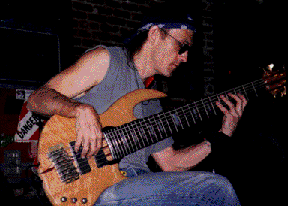
 Are you using the 7-string bass on all of this
album?
Are you using the 7-string bass on all of this
album?Are there many joint writing collaborations
with Chris on this?
Some songs Chris wrote and
some songs I wrote most of, but somehow the other partner sort of completes
it. He’ll come in with something and I’ll find something about
it in the groove. “My Way Down” is a good example. He came in
and he had the lyrics and the guitar part with the Stevie Wonderish-in heat-on
acid-kind of groove. My contribution was that 16th note bassline which led
to the drum part, the part where it breaks down after the solo, that big
Earth, Wind & Fire stomp-thing. And “.32 Blues” is my lyric
and basic melody - but can you imagine it without Chris?! I can’t.
I’m more than happy to give him credit on stuff.
What songs did you write, at least
as a starting point?
“.32 Blues”, “Crash”
and “Crimino”.
Has your approach to songwriting
changed any after this album?
I’m always looking for
the groove! That’s what tends to come to me first. Or experiences.
A good example is “.32 Blues”. One of my best friends I’d
known since high school called me up. We hadn’t talked in years! He
calls me up one night and tells me about this experience which came to be
“.32 Blues”. It really happened to him. It was a long story with
all these great details. I started out where the first page was almost a
short story. I was just trying to get in all the details, these great images,
like feeling the cold breeze from the back door opening. He was at this
junkie’s house, collecting money from her, as a favor he owed a friend,
like in the first verse, “It ain’t for me honey”. The only
piece of furniture, everything else had been hocked, was this glass table
with brass balls at the corners. In one of them he saw this blurry, distorted
image of someone coming up behind him! He turned around as this guy swings
a baseball bat at his head and just misses! So my friend puts this guy down,
smashing the glass table as he falls. He turns around and she has a .32
pointed at his face! She pulls the trigger and it misfires! He takes it
away from her and just walks away. That’s the song. So I had all of
these images that I wanted to get into the song and the groove I’m
hearing is a Howlin’ Wolf kind of thing, a primitive blues. So I kept
reworking the images, stripping things out, sort of like Haiku, trying to
get to this groove I was hearing in my head. You can’t be too flowery
when you’ve got this chuggin’ groove! I was trying to match the
lyrics with the mood of the groove, too. It’s the first thing that
defines the song.
On “.32 Blues”, the eerie
drumsticks ticking like a clock, was that Greg Morrow’s idea?
No, David Z came up with that.
It was real clever. We learned a lot from Dave.
Chris had said he learned some vocal
techniques from him.
You listen on the tape and
you can hear him suckin’ air a lot and stuff. David kept saying, “Breathe!
Breathe!”, like a football coach! “You’re not breathing!
Run it back again! I want to hear you! I want you to be hyperventilating
and passing out when you’re through singing!”
What did you pick up from David?
The biggest thing I got from
him was the idea of vowels. In classical music and opera it’s the vowels
that define the vocal style, but in pop music it’s how you approach
the consonants, the hard sounds. I had heard about it before, on a radio
interview, but it was amazing what a difference it makes! When we got in
the studio, Chris was singing “Hungry” and Dave said to shorten
the vowels and make the consonants hard. It was amazing how that focused
it. It was seeing that principle illustrated, and understanding it, that
was the biggest thing I learned from him. Chris, being the singer, has transferred
that over to the live shows as well. Myself, being a writer and recording
music, it was really a big thing! David’s approach is in terms of Black
American dance music. He comes from an R&B place, his work with Prince
and stuff. He wanted the solos to be poppin’ with the groove. “Go
back, do it again, it’s not poppin’ with the groove!” So
that’s how he thought. But that’s not the only way to go about
it. For example, when we went to Toronto we were doing “Cleopatra”.
Chris played this real wacky part in the solo, it was kind of outta’
the groove, and I said so (after working with David Z for a month), but
actually everyone loved it and I love it, too. It’s cool! He had influenced
my thinking into how everything was related to the groove. If you took away
everything but the vocal you could still imagine what the groove would be.
So that also was a big influence on me. And watching him work vocally. I
just learned tons from him ‘cuz I was there for the whole process.
Sometimes it’s a fairly agonizing process, sometimes word by word,
because he was so meticulous about it.
Did you have a pretty tight song
list going into this album?
Pretty much. On “Texas
Sugar” they had tape rolling all the time. They would turn on and we
would play. We had a pretty strong list going into this record. I think
it’ll be called “Tailspin”. “Walls” is what Chris
and I would like, but I think it’s gonna’ be “Tailspin”.
We don’t care really. How about “Music” or “Wow!”,
whatever, you know? But on this record we had a real set idea of what we
wanted to do. David kept saying we need a slow song, something that really
changes the mood. We showed him “People Get Ready” and some different
things, but none of it was what he was looking for. Finally I said we’ve
got this great song Chris wrote, which I just adore, called “Walls”.
So Chris pulled out one of his Epiphones and played it and they said to
try it. We went in and recorded it in 2 or 3 takes - boom, boom, boom -
and it was done. Wow! This thing, it’s just, that whole guitar solo
was what happened, no overdubs or anything!
Was that true with most songs, just
a few takes?
I don’t remember any one
song taking a whole lot of work. We did “Cleo” twice in Nashville.
We had one that was quick and peppy and one that was slower. We ended up
taking the slower one up to Toronto and redid the whole thing. That’s
the one that’ll be on the album.
On one of the other Toronto cuts,
“The Thrill Is Gone”,
I heard keyboards. Was that Reese Wynans, too?
No, that was Gordie Johnson
and me. They had a tape loop comprised of a Donovan tune, of all things,
and B.B. King testing his reverb and slapping his muted strings!
That’s actually them sampled!?
Yeah, it’s an actual sample.
So it’s Chris playing with Donovan and B.B. and whatever else. Gordie
had put this guitar thing on top and Chris said he wasn’t hearing enough
tonality to feel the song. Se we decided to put some keyboards on it. It’s
a funny key ‘cuz we’re tuned down a half-step. It was an A-Flat
minor when you transfer it to the keyboard. So I went in and showed Gordie
the piano voicings and then he played it. He also played this cheesy organ
on the hook, to fatten it up. This old-style, weird thing. He would double
up my bass parts to get this real fat thing. It added a tonal fatness to
it.
Did you record “The Thrill Is
Gone” in Nashville, too?
No, we didn’t even talk
about recording it. Mike Tedesco has always liked the way we did the song.
Before we got up there (Toronto) they had kind of come up with this whole
thing really.
What about “Catch The Next Line”?
The Toronto version is so different than the Nashville track.
That’s Gordie playing
the rhythm part at the beginning of it. That arrangement was pretty much
his idea. He said, “Look guys, I can’t tell you how to improve
on a Texas Shuffle. I’m a Canadian! But I’ve got this idea I’d
like you to try.” So we did and it really felt good. It reminds me
of NRBQ, it has that rockabilly kind of thang.
Where you involved much with the
production of the album?
Oh yeah, I was way in there.
Me and Chris both. I felt real comfortable expressing myself. Some of my
ideas were taken and embraced and others were hooted out of the room! But
that’s the nature of it all.
Did you learn production techniques
from David, too?
It’s kind of arcane to
describe, but in terms of using common machines in the studio in unusual
ways.
For effect?
Yeah, like using a gate. It
limits peaks and raises the dynamic range of quiet parts. He would use that
at a certain setting and the effect was to make it sound like a clavinet.
On “People Say”, that funky, clavinet-sounding thing is Chris
playing his guitar through this studio rack effect. Just little cool things
like that. And his use of sampling, not just recorded samples, but he had
this little sampling machine and he would get one perfect phrase of the
chorus and then, instead of having Chris try to get it perfect 20 times,
he would use the sample instead. Just throw it in there, it was great. But,
believe me, if it had sounded artificial or digital or something it would’ve
gone straight out the nearest window!! It was a wonderful timesaver.
Did having rehearsal time before
recording make a difference?
No, not really. I think David
would agree. Greg, too. It was fun to hang out and get to know each other
but, musically, it was essentially meaningless. We’d already rehearsed
more this year, writing songs, spending a lot of time at the ARC (Austin
Rehearsal Complex) with Frosty and Erick. It became more normal for us to
rehearse than it used to be. Everyone was a real good musician and the ideas
were flowing real good, but we could’ve spent that time in the recording
studio just as well, or come a week later. It probably gave David a couple
of ideas, but it wouldn’t have taken him long to come to those ideas
anyway. Like the drumsticks clicking on “.32 Blues”, he came up
with that in the rehearsal studio. He’d seen us at a show at Steamboat
in Austin and had listened to a tape of it and one from another producer
at a gig in San Marcos. So he’d heard a lot of these songs beforehand
and formulated some ideas then.
How did you link up with Reese Wynans?
Was he recording there in Nashville?
David Z brought him in. Reese
is a Nashville musician now. He’s lived there a couple years as a studio
musician and David called him in.
I really like his organ work on the
album.
I do, too. The thing about
Reese is he’s one of the few people who really knows how to play the
damn thing! You can’t just be a piano player and sit down and translate
that to the organ. It’s a completely different instrument that just
happens to have black & white keys! You’ve got sustain and all
these different settings and Reese actually knows how to play the thing.
Reese is just a great musician. His contribution to “.32 Blues”
was just lovely. He had a great time and had fun being there and we had
a lot of fun having him there.